SEO
What Agentic SEO Actually Means — And Why Most "AI SEO" Tools Aren't It
Agentic SEO is autonomous, tool-using, multi-step search optimisation — not a chatbot writing blog posts. A practitioner's definition, a five-question vendor litmus test, and what genuinely agentic systems do differently.
Key takeaways
- Agentic SEO is autonomous, tool-using, multi-step search optimisation — an agent plans, calls tools, observes results, and adjusts without a human approving every step.
- It's not AI-assisted writing, automated SEO, or a Surfer plug-in with a chat box. Most products marketed as "AI SEO" in 2026 are one-shot generators, not agents.
- Use the five-question litmus test below to separate genuine agentic systems from repackaged GPT wrappers.
- The category got named in industry press in April 2026 — Backlinko, Search Engine Land, Fountain City — and the protocol layer underneath (MCP, A2A, NLWeb, WebMCP) is "what robots.txt was to 2005 Google".
- Google AI Overviews fire on roughly 80% of commercial SEO queries we tracked across US and UK SERPs in May 2026. The job is no longer ranking; it's being cited.
Table of contents
- The 48-word definition
- Agentic SEO vs AI-assisted SEO vs automated SEO
- The five-question vendor litmus test
- What "AI SEO" usually means in 2026
- What a genuinely agentic system looks like in production
- Where vendors get it wrong — four failure patterns
- Why this matters now — AI Overviews, GEO, and the citation economy
- How to brief an agentic SEO project — a seven-step starter
- FAQ
- The bottom line
The 48-word definition
Agentic SEO is the use of autonomous, tool-using AI agents that plan, execute, and iterate across the SEO lifecycle under goal-level instructions rather than per-prompt instructions. The agent decides what to do next, calls the tools it needs, observes the result, and adjusts — without a human approving every step.
That's the whole definition. Forty-eight words, no padding. The rest of this piece is about what those words exclude, and why the exclusion matters when you're about to spend money.
The term landed in industry press in April 2026. Amanda Milligan's Backlinko piece on agentic AI protocols called the underlying protocol layer — MCP, A2A, NLWeb, WebMCP — "what robots.txt was to 2005 Google". A week later Search Engine Land published Google AI director commentary outlining the playbook. Fountain City's practitioner guide shipped the same week. The vocabulary now exists. The discipline is older — Princeton, Georgia Tech and Allen AI's foundational GEO paper from November 2023 named the upstream problem of optimising for generative engines two years before agentic SEO got its name.
Agentic SEO vs AI-assisted SEO vs automated SEO
Four adjacent categories get blurred. The differences are not aesthetic.
| Category | Reasoning loop | Owns execution? | Typical surface | What it ships |
|---|---|---|---|---|
| Automated SEO | None | Yes (deterministic scripts) | Google SERP | Crawl reports, schema injectors, indexing pings |
| AI-assisted SEO | Per-prompt | Partial (human still drives) | Google SERP + AI Overviews | Briefs, drafts, optimisation suggestions |
| Programmatic SEO | None (data-driven templates) | Yes (template render) | Long-tail Google SERP | Thousands of templated pages |
| GEO / AEO | None — it's a content-design discipline | No (content spec only) | LLM citations | Quotable passages, schema, citable structure |
| Agentic SEO | Multi-step, persistent, tool-using | Yes (autonomous) | SERP + LLM citations | End-to-end orchestrated campaigns |
The headline difference: agentic SEO can contain the other four. A properly built agentic system runs programmatic page generation as one of its sub-tasks, runs the GEO content-design pass as another, and treats classical automated SEO (indexing, schema, internal links) as low-level utilities the agents call when needed. Read the agentic SEO pillar for the deep comparison.
If the product you're evaluating can't describe the loop — the thing that decides what to do next — it isn't agentic. It's one of the other four with a chat interface bolted on.
The five-question vendor litmus test
Apply this on any sales call. Five questions, two minutes. You'll know within the first answer.
- "Show me the agent's state between steps. Where does it live?" Agentic systems carry state — what they've learned, what they've tried, what failed. If the answer is "the chat history" or "we re-prompt with the full context every time", you're looking at a wrapper, not an agent. Durable state usually lives in Postgres, Redis, or a graph framework's checkpoint store.
- "What tools can the agent call, and how does it choose between them?" A real agent has a tool registry — SERP APIs, crawlers, schema validators, indexing endpoints, vector stores — and picks from them dynamically. If the workflow is fixed ("keyword → brief → draft → publish"), it's automation with an LLM in one slot.
- "Walk me through what happens when step four fails." Genuinely agentic systems retry, branch, or escalate to a human. If the answer is "the job errors out and we restart from the beginning", there's no agent. There's a script.
- "How do you handle human-in-the-loop gates for YMYL content?" Legal, medical and financial pages need approval gates. The right answer names specific gates (pre-publish, schema-at-scale changes, disavow commits) and explains why each one exists. The wrong answer is "we have a review step."
- "What model versions are pinned, and how do you swap them?" OpenAI deprecated GPT-5 Instant + Thinking with two weeks' notice in February 2026. Anyone running production agents without pinned versions and a provider-abstraction layer (LiteLLM, OpenRouter, or equivalent) is one announcement away from a silent regression.
If a product fails three of the five, it's AI-assisted SEO sold as agentic. That isn't necessarily wrong — AI-assisted SEO is fine, often the right tool for a ten-article-a-month operation. It's only wrong when the pricing assumes you're buying autonomy.
What "AI SEO" usually means in 2026 — and why most of it is repackaged
The flagship US head term `ai seo agency` carries 880 monthly US searches and 480 UK searches at KD 8 (live SERP API run, 20 May 2026). It's one of the most contested phrases in the category. Reddit owns the US #1. Eight of the top ten organic pages we audited use the phrase "AI SEO" to mean one of three things:
- A content tool with a model in it. Surfer's NLP editor. Frase's brief generator. Clearscope's relevance scorer. Useful products. Not agents.
- A workflow tool that calls a model on one step. AirOps, Zapier-with-OpenAI, n8n + GPT-4o. These are orchestration layers. They become agentic when the orchestration includes reasoning, tool selection and state — most published workflows don't.
- A pure GPT wrapper with an SEO prompt library. Often white-labelled, often priced as agency-grade. The pricing is the giveaway: if the per-article cost is below £5 and the deliverable is a Word document, you're paying for a prompt template.
None of these are scams. They solve narrower problems. The category misuse happens when "AI SEO" gets sold as a replacement for an agency, a strategist or a head of growth, on the implicit promise that the agent is making decisions. Usually it isn't.
The Reddit threads dominating the SERP for `ai seo agency` say this more bluntly than I will.
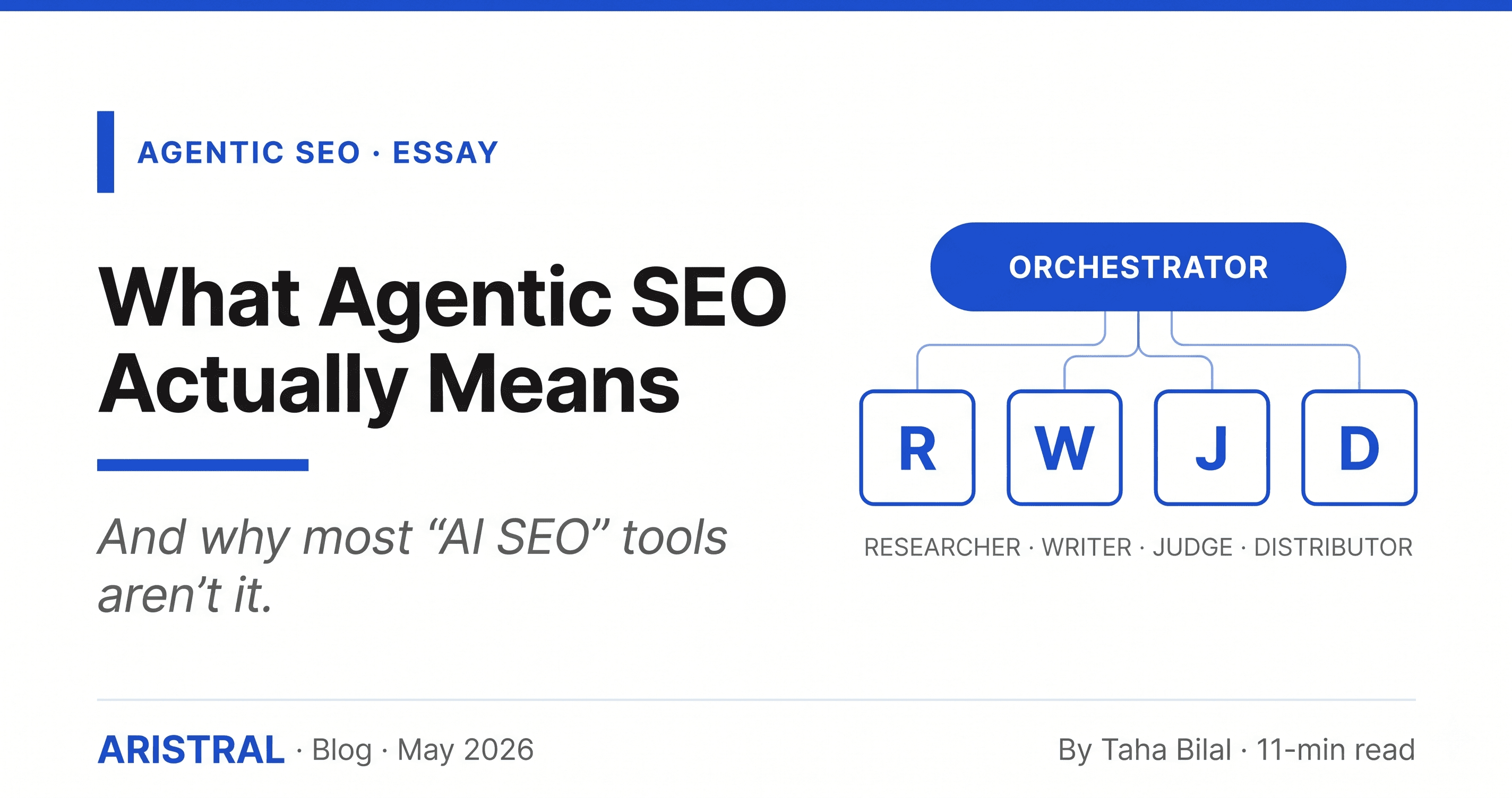
What a genuinely agentic system looks like in production
Four agent roles. One orchestrator. A handful of guardrails. The shape mature production setups converge on is consistent across the better end of the SaaS market, the practitioner write-ups from Fountain City, AirOps's published architecture, and the protocol-layer commentary out of Backlinko and Search Engine Land.
The four roles:
- Researcher — crawls, scrapes structured data, queries SERP APIs, builds a working brief. A small, fast model handles the high-volume read operations because cost compounds quickly here.
- Writer / strategist — drafts the brief, the outline, the copy. A mid-tier model carries the creative load.
- Judge — evaluates the writer's output against a golden set of past wins and losses. A frontier-class model, called sparingly because it's expensive.
- Distributor — publishes via CMS APIs, validates schema, pings IndexNow, watches GSC for the ranking response.
The orchestrator is the load-bearing piece. A durable, graph-based orchestration framework is the current default for serious production work — anything that gives you persistent state, branching, cycles and audit trails. Lighter-weight crew-style frameworks are fine for prototypes, painful at scale. Workflow tools like n8n still have a place for client-facing automation bolt-ons, but widely-shared 2026 operator commentary — Samin Yasar's much-circulated breakdown, plus a string of public postmortems on 15–20 minute stalls reading 2,000+ row GSC exports — pushed most teams off n8n for the agent core in early 2026.
The guardrails that matter:
- Pinned model versions in config, swapped via a provider-abstraction layer.
- Hard monthly cost caps per client, with auto-degrade to a cheaper model at 80% budget consumption. The £240 → £950 cost blowup pattern in n8n is real and unprovoked.
- Cannibalisation pre-flight — embedding similarity against the live sitemap before a single draft is written.
- Schema validation in CI, not in production. Run the Rich Results Test on every page before publish.
- LLM-as-judge nightly regression on a hand-graded golden set. Target 75–90% agreement with human labels.
It's the layer most "AI SEO" products skip, because it's engineering, not marketing.
Where vendors get it wrong — four failure patterns
Patterns we see repeatedly on audits:
1. Prompt-in-a-box. A long, carefully-crafted SEO prompt loaded into a generic interface. No tool use. No memory. No state. Useful for individual drafts; uneconomic at fifty pages a month.
2. One-shot generation. "Give me a 2,000-word article on X." The model writes once, returns once, ends. No fact-check, no rewrite, no judge pass. This is where the documented 10% factual error rate of AI Overviews shows up in the wild — agents inherit the same rate unless something explicitly checks the work.
3. No recovery. Step three fails — the SERP API rate-limits, the CMS rejects the schema, the indexing call 500s. A non-agentic system errors out. An agentic one retries on a different endpoint, branches to a fallback, or pages a human. The recovery behaviour is the agent.
4. Marketing schema, not real schema. The page outputs JSON-LD that looks correct in the source but fails validation. The five recurring failure classes are catalogued in the Schema Markup Validator guide. The fix is CI — not "we tested it once and it worked".
Why this matters now — AI Overviews, GEO, and the citation economy
In May 2026 we ran 55 SERPs through a live SERP data API across US and UK queries in this category. Google AI Overviews fired on 80% of US commercial queries and 85% of UK commercial queries. The top AIO-cited domains, in order: Reddit (24 citations), YouTube (14), Search Engine Journal (8), Level.agency (7), seo.co (7), seo.com (7).
The job is no longer ranking. The job is being cited.
That changes what an SEO agent has to do. A non-agentic pipeline can produce a well-optimised page. An agentic pipeline can produce a page, check whether the page got cited, work out which passage Google's AI Overview pulled, and reshape the next page around the citation pattern that worked. That feedback loop is the part most "AI SEO" tools can't run, because they don't own the monitoring layer.
This is why generative engine optimisation (GEO) and agentic SEO are converging. GEO defines what a citable passage looks like — sub-60-word definitions, answer-first structure, statistics with source attribution, schema-friendly patterns. Agentic SEO is what builds, ships, monitors and rewrites at the cadence that makes GEO a measurable discipline rather than a checklist.
How to brief an agentic SEO project — a seven-step starter
If you're commissioning this internally, in an agency, or with a vendor, these are the seven inputs the brief needs to carry. Skip any of them and you'll end up with a script in agent's clothing.
- Goal definition at the campaign level, not the article level. "Win citation in AI Overviews for 12 of our top 20 commercial queries in two quarters" is a goal an agent can plan against. "Write four articles a week" is a task list.
- A bounded tool registry. Which APIs, which crawlers, which CMS endpoints. With auth scopes. Without it, the agent can't act.
- A golden set — 30 to 100 hand-graded examples of pages that won, pages that lost, and pages that cannibalised. This is the eval substrate. Without one, the judge agent has nothing to compare against.
- A model routing policy. Which steps use the cheap model, which use the mid, which use the heavyweight, and the budget cap that triggers auto-degrade.
- Human-in-the-loop gates. Named, not abstract: pre-publish on YMYL, brand voice sign-off on first five drafts per new client, schema mass-changes, disavow commits. Cut the theatre gates — per-keyword approval, per-meta-description approval — they slow the loop without adding safety.
- A schema discipline. Article + FAQPage + Organization on every page via a layout-level injector, with HowTo / LocalBusiness / ItemList added where the page type calls for it. Single JSON-LD block per page.
- A measurement layer that includes AIO citation, not just rankings. Tools like Profound, llm.report, and well-designed manual SERP capture cycles work. Treat AI citation as a KPI alongside organic position.
If your incoming brief from a vendor covers four of these seven, you're in good shape. If it covers two, ask why.
FAQ
What is an agentic SEO?
An agentic SEO is a system — or a service powered by one — where autonomous AI agents plan, execute and iterate SEO work across multiple steps. The agents call tools, observe results, and adjust without a human approving every move. It's distinct from AI-assisted SEO, where a human directs the AI on each prompt.
Is SEO dead or evolving in 2026?
Evolving, sharply. Google AI Overviews now fire on roughly 80% of commercial SEO queries we tracked in May 2026. Classical ranking still matters because top-ten organic positions feed the AIO source pool. The job has expanded from "rank" to "rank and be cited inside the AI answer".
What's the difference between SEO and agentic search?
SEO is the discipline of earning visibility in search engines. Agentic search refers to AI agents — Perplexity, ChatGPT Search, Google AI Mode — that retrieve, synthesise and answer on the user's behalf. Agentic SEO optimises content so those agents cite it. Classical SEO and agentic search are about different actors in the same value chain.
What's the 80/20 rule of SEO?
In agentic SEO specifically, 20% of the work — schema discipline, citable passage structure, internal linking, and the eval loop — produces 80% of the citations. Most of the rest is execution at cadence. The Pareto split holds, but the high-value 20% has shifted from keyword research to citation engineering.
What are four types of SEO?
Conventionally: on-page, off-page, technical, and local. In 2026 it's more useful to think in terms of surfaces: classical organic search, AI Overviews and AI Mode, conversational AI (ChatGPT, Perplexity), and vertical engines (YouTube, Amazon, App Store). Agentic SEO targets all four because the same agent can run the work needed for each.
Is agentic SEO the same as automated SEO?
No. Automated SEO runs deterministic scripts — scheduled crawls, indexing pings, schema injectors. Agentic SEO runs autonomous agents that decide what to automate next. Automated SEO is the toolbox; agentic SEO is the system that picks tools out of the toolbox in response to what it observes.
How much does a real agentic SEO setup cost?
The 2026 market splits in three. Tools-only AI SEO products sit at £20–£250/month (Frase Starter, Surfer Peace of Mind, Clearscope Essentials) — they help you write and edit, they don't execute. Workflow tools billed by usage (AirOps and similar) can clear £1,000/month at agency volume because pricing scales with tasks rather than seats. Managed agentic SEO services sit higher again, varying by output cadence, multi-market needs, and human-in-the-loop intensity, but they replace the execution layer wholesale rather than just the writing layer. For how Aristral packages this, see our AI automation agency page.
The bottom line
Most products marketed as "AI SEO" in 2026 are useful tools. They aren't agents.
A genuine agentic SEO system has a loop, a tool registry, durable state, retry behaviour, model versioning, and human-in-the-loop gates that exist for documented reasons. A vendor who can describe all six is selling agentic SEO. A vendor who can describe two is selling AI-assisted SEO at agentic prices.
The five-question litmus test will save you a quarter of wasted budget on the next evaluation call.
If you want the full architectural treatment — the agent stack, the orchestration choices, the buy-vs-build matrix — read the agentic SEO pillar. If you want to see how we package this for client work, our SEO services and AI automation agency pages cover the offer without the marketing copy.
Sources cited
- Amanda Milligan — The 6 Agentic AI Protocols Every SEO Needs to Know, Backlinko, 13 April 2026
- Agentic engine optimization: Google AI director outlines new content playbook, Search Engine Land, 15 April 2026
- Agentic SEO: What It Is & How We Run It in Production, Fountain City, 12 April 2026
- Aggarwal et al. — GEO: Generative Engine Optimization, Princeton / Georgia Tech / Allen AI, November 2023
- OpenAI axes ChatGPT models with two weeks' warning, The Register, 30 January 2026
- How to Track AI API Costs in n8n Workflows, Cledara, 2026
- Google's AI Overviews and Publisher Traffic, ALM Corp, 2025
- Schema Markup Validator: The Complete Guide, Schema Engine, 2025/2026
Methodology
SERP and keyword data in this piece was pulled live from commercial SERP and keyword data APIs on 20 May 2026. Sample: 47 keywords, 55 SERPs across US, UK, Germany and Canada. AI Overview triggers reported here are API-confirmed, not inferred. Raw artefacts kept on file. Industry source dates verified at time of writing. Aristral doesn't accept affiliate revenue from any tool named here.
About the author
Taha Bilal
Founder, Aristral
Taha Bilal is the founder of Aristral, a UK AI automation and SEO agency based in Clifton, Bristol. He has been running SEO and digital-growth campaigns for SMB and SaaS clients since 2018, and now leads Aristral's combined SEO + GEO programmes for service businesses across the UK and US. Corrections and source requests: [email protected].
LinkedIn →Filed under: SEO